
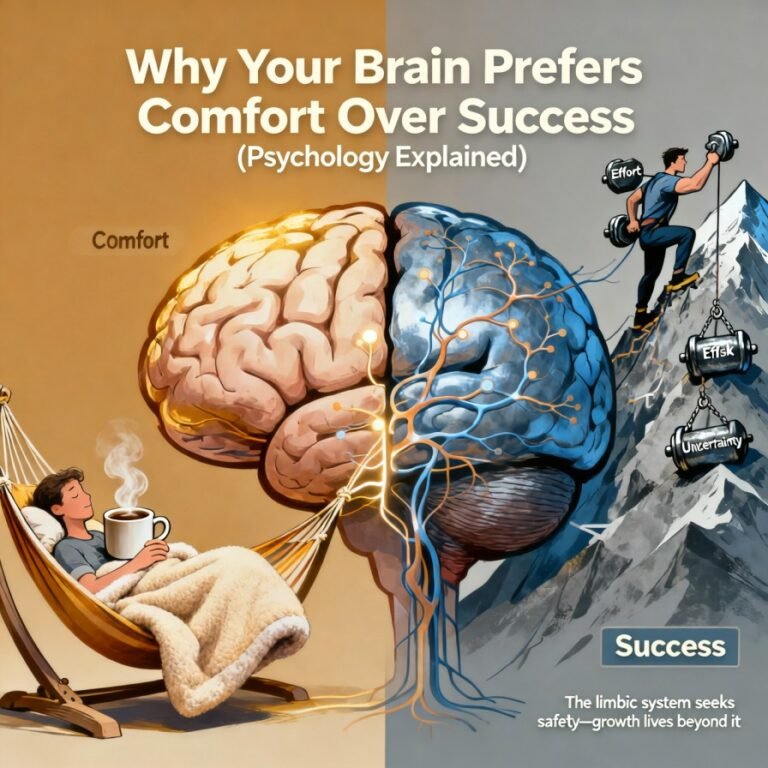

Why Your Brain Prefers Comfort Over Success Psychology Explained Have you ever hit snooze on your alarm, scrolled endlessly instead of working on that big goal, or stuck with a job you outgrew just because it felt safe? You’re not lazy or unmotivated—it’s your brain at work. Psychology shows that our minds are wired to prioritize comfort, a survival hack from our ancestors that now often sabotages modern success. But what if understanding this could help you rewrite the script? Let’s explore why this happens and how to shift the balance.
Comfort vs. Success: A Tale of Two Paths
Comfort and success might seem like allies, but they’re often at odds. Comfort lures us with familiarity and low risk, while success demands stepping into uncertainty. Research from evolutionary psychology highlights how our brains evolved to favor the former, equating change with danger. Yet, embracing discomfort can lead to breakthroughs.
To illustrate, consider this comparison:
| Aspect | Comfort Path | Success Path |
|---|---|---|
| Brain’s Focus | Survival and predictability | Growth and adaptation |
| Emotional State | Low anxiety, routine satisfaction | Initial fear, eventual fulfillment |
| Outcomes | Stagnation, missed opportunities | Resilience, self-confidence, achievement |
| Examples | Binge-watching instead of exercising | Starting a side hustle despite doubts |
As Forbes contributor Sujan Patel notes, discomfort activates unique brain regions, releasing dopamine that fuels long-term gains. But why does the brain resist?

Navigating the Journey: From Comfort Zone to the Growth Zone
The Evolutionary Roots: Survival Over Thrival
From an evolutionary standpoint, our brains aren’t built for TED Talks or career ladders—they’re designed for caves and saber-toothed tigers. Psychology Today explains that humans evolved a “survival instinct” to avoid unfamiliarity, unpredictability, and loss of control, states that once signaled imminent death. Today, this manifests as clinging to comfort zones, where predictability equals safety.
Consider our ancestors: Venturing out meant risks like predators or scarce resources. Sticking to known paths conserved energy and boosted survival odds. As Paul Gilbert’s work in evolutionary psychology suggests, this “thrival instinct”—curiosity and exploration—exists but is often overridden by survival needs. In modern life, this means scrolling social media for quick dopamine hits instead of pursuing ambitious goals, as the brain sees change as a threat.
A fresh perspective: In today’s digital age, algorithms exploit this by feeding us endless familiar content, creating “echo chambers” that reinforce comfort but stifle diverse thinking. Personal note—I once delayed launching a podcast for months, fearing judgment, until realizing it was my brain’s ancient wiring at play.
The Neuroscience Angle: Fear Circuits and Reward Shortcuts
Delving into neuroscience, the amygdala—our brain’s threat detector—plays a starring role. According to a Psychology Today article, it triggers fear of the unknown, promoting overcautious behavior even when risks are low. This “psychological trap,” as expert Tevlin calls it, creates a false sense of safety that hinders growth.
Under stress, the prefrontal cortex (decision-making hub) biases toward short-term rewards, like procrastination, over long-term success. A study in Neuron reveals that new experiences release dopamine only in novel situations, but initial discomfort deters us. Self-sabotage? It’s a safety strategy, per Substack’s Contemplation Station: The brain prefers predictability, encoding habits in the basal ganglia for automatic comfort-seeking.
Unique insight: Think of your brain as a GPS set to “avoid tolls”—it picks the easy route, but success often lies on the scenic, bumpy path. Environmental factors matter too; PMC research shows comfortable settings expand “desire zones” in the nucleus accumbens, making us more open to risks, while stress shrinks them.

Designing with Neuroscience: Unveiling the Brain’s Secrets for …
Psychological Barriers: Why We Stay Stuck
Psychology outlines clear barriers. Fear of failure tops the list—past rejections wire us to avoid risks, per Medium’s Ria Vanessa Caliste. Low self-confidence keeps us doubting our abilities, while societal pressures favor conformity.
TalktoAngel discusses “comfort creep”: Easy rewards like takeout or streaming adapt our dopamine system to expect minimal effort, making hard work feel intolerable. Walden University notes pros like confidence and low risk, but cons include no new skills and a shrinking comfort zone.
Harvard Summer School adds that we’re wired to shy away from threats, but small steps build resilience. In my experience, starting small—like cold showers to build tolerance—helped override these barriers.
Breaking Free: Strategies for Growth
Ready to rewire? PositivePsychology.com advises reframing stress as excitement—physiologically similar, it turns anxiety into energy. NeuroLeadership Institute emphasizes “optimal arousal”: Mild discomfort boosts performance without panic.
Practical tips:
- Small wins: Start with micro-habits, like 5-minute journaling on fears.
- Sacrifice comforts: Silicon Canals lists eight, including sleeping in and avoiding conflict—successful people trade these for growth.
- Build support: Hartstein Psychological highlights how new experiences boost creativity and confidence.
- Mindset shift: Embrace a growth mindset (Dweck); view failures as data.
Northstar Counseling warns anxiety shrinks zones, but exposure therapy expands them. Forbes stresses that discomfort forges neural pathways for creativity.
A table of steps:
| Step | Action | Benefit |
|---|---|---|
| Assess | Identify your zones | Builds self-awareness |
| Reframe | Label discomfort as growth | Reduces fear response |
| Act | Take one small risk daily | Releases dopamine, builds momentum |
| Reflect | Journal outcomes | Reinforces positive changes |
Wrapping Up: Choose Growth, One Step at a Time
Psychology makes it clear: Your brain prefers comfort because it’s a survival relic, but success thrives on managed discomfort. By understanding evolutionary wiring, neuroscience biases, and psychological hurdles, you can push beyond. Remember, as Tevlin says, “Recognizing this is the first step.”
What’s one comfort you’re ready to sacrifice? Share in the comments, explore related posts on growth mindsets, or subscribe for more insights on psychology and personal development. Let’s grow together!
In this comprehensive exploration, we delve deeper into the psychological mechanisms at play, drawing from authoritative sources to provide a nuanced view. The brain’s preference for comfort isn’t a flaw—it’s an evolutionary adaptation that once ensured survival but now often limits potential in our abundant world.
Evolutionary Foundations: From Caves to Comfort Zones
Evolutionary psychology, as outlined in Psychology Today’s “The Power of Prime,” posits that our survival instinct prioritizes equilibrium over exploration. Unfamiliarity signaled danger in ancestral environments, leading to avoidance behaviors embedded in our DNA. Gilbert’s research on affiliative emotions shows how seeking safety through social bonds further reinforces this, but modern mismatches—like endless digital distractions—exploit it, creating “comfort creep” where baselines shift toward ease (TalktoAngel).
A counterpoint: The “thrival instinct” drives curiosity, but it’s secondary. In hunter-gatherer times, high anger levels aided defense (ReachLink), yet today, this manifests as resistance to change. Fresh angle: Social media’s “like” economy mimics tribal validation, keeping us in echo chambers that feel safe but hinder diverse perspectives.
Neuroscience: The Amygdala’s Grip and Dopamine’s Pull
The amygdala scans for threats, interpreting uncertainty as danger and triggering overcaution (Psychology Today, 2024). Under stress, the prefrontal cortex favors short-term rewards, per Contemplation Station, leading to self-sabotage as a “safety strategy.” PMC’s pleasure systems study reveals an “affective keyboard” in the nucleus accumbens: Comfort expands desire for rewards, while stress amplifies dread.
Forbes (2016) notes new situations forge neural pathways, releasing dopamine uniquely in novelty—but initial resistance is strong. NeuroLeadership’s “optimal arousal” echoes Yerkes-Dodson: Mild threat enhances performance, but boreout from too much comfort dulls cognition. Personal reflection: My hesitation to network stemmed from this; forcing exposure rewired my response.
Psychological Dynamics: Barriers and Biases
Walden University balances pros (confidence, low risk) with cons (stagnation, missed growth). Harvard warns of wired threat aversion, but stepping out builds self-agency. Medium lists 10 reasons we stay: Fears of unknown/failure, low confidence, past traumas, and complacency.
Psych Central offers an alternative: Comfort zones aren’t traps but consistency hubs; optimal anxiety just outside boosts performance without panic. Silicon Canals’ 8 sacrifices—e.g., certainty, perfection—align with psychology’s view that high achievers embrace discomfort.
Pathways to Override: Evidence-Based Strategies
PositivePsychology.com maps zones: Comfort to fear, learning, growth. Tips include reframing stress (Smith et al., 2005) and leveraging neuroplasticity (Dweck). Hartstein’s 5 reasons to leave: Strength, creativity, confidence, development, new experiences.
Northstar emphasizes anxiety’s role in shrinking zones, but gradual exposure builds resilience. NeuroLeadership advises small steps for “productive discomfort.” Table from earlier expands here with research:
| Barrier | Strategy | Supporting Evidence |
|---|---|---|
| Fear of Failure | Embrace small risks | Bandura’s self-efficacy boosts from mastery |
| Low Confidence | Reframe as excitement | Physiological overlap reduces anxiety |
| Habitual Comfort | Disrupt routines | Forbes: New pathways enhance creativity |
| Societal Pressure | Build support networks | Gilbert: Affiliative emotions aid coping |
Unique insight: Incorporate “digital detoxes” to break algorithm-driven comfort, fostering real-world risks. In practice, I started with weekly “novelty days,” trying one new thing— it transformed my mindset.
Balanced View: When Comfort Serves
Not all comfort is bad; it’s restorative (Walden). Psych Central urges avoiding complacency without constant pressure. Evolution’s dual instincts—survival and thrival—suggest balance: Use comfort for recovery, discomfort for progress.
In conclusion, psychology illuminates this bias but empowers change. By sacrificing comforts and embracing managed risks, we align ancient wiring with modern ambitions.
Also Read:10 Psychology Facts That Quietly Control Your Daily Decisions