


Have you ever wondered why some people seem to thrive amid challenges while others falter? It often boils down to mindset—the invisible force shaping our responses to life’s hurdles. In the realm of self-improvement, adopting the right mindset shifts can propel you toward long-term success, turning obstacles into stepping stones.Mindset Shifts for Long-Term Success
Key Points:
- Research suggests that a growth mindset, where abilities are seen as developable through effort, leads to greater resilience and achievement compared to a fixed mindset.
- Embracing progress over perfection fosters consistency in self-improvement, reducing burnout and encouraging small, sustainable actions.
- Unique perspectives, like viewing failure as neutral feedback rather than defeat, can accelerate personal growth, though this requires practice and self-compassion.
- Evidence leans toward the idea that mindset is changeable; even those with fixed tendencies can cultivate growth through targeted strategies, promoting optimism and adaptability.
- While mindset shifts offer powerful tools, they work best when balanced with real-world actions, acknowledging that individual contexts may influence outcomes.
Understanding Mindset Basics At its core, self-improvement thrives on mindset. Pioneered by psychologist Carol Dweck, the distinction between fixed and growth mindsets highlights how our beliefs about abilities impact success. A fixed mindset views talents as innate and unchangeable, often leading to avoidance of challenges. In contrast, a growth mindset sees potential for development, embracing effort as key to mastery. This shift can enhance motivation and resilience, making long-term goals more attainable.
Why These Shifts Matter In a fast-paced world, mindset shifts provide a foundation for sustainable self-improvement. They encourage viewing setbacks as learning opportunities, fostering empathy for oneself and others. For instance, integrating positive framing—choosing to see the good in daily experiences—can reduce stress and boost overall wellbeing. Approach these changes with openness, as they may challenge ingrained habits but yield profound results.
Practical Starting Steps Begin by assessing your current mindset: Reflect on recent challenges and note your reactions. Adopt one shift, like trusting yourself more, and track progress weekly. Resources like Dweck’s insights or habit-building tools can guide you. Remember, self-improvement is a journey—be patient and celebrate small wins.
In the pursuit of long-term success, mindset serves as the compass guiding our self-improvement efforts. This comprehensive exploration delves into the transformative power of mindset shifts, drawing from psychological research, expert insights, and practical strategies to help you cultivate lasting change. We’ll examine the foundational comparison between fixed and growth mindsets, uncover key insights from leading thinkers, and provide actionable tools to integrate these shifts into your life. Whether you’re navigating career ambitions, personal relationships, or inner growth, these perspectives offer a roadmap to resilience and fulfillment.
The Foundation: Fixed vs. Growth Mindset
Central to self-improvement is the mindset framework developed by Stanford psychologist Carol Dweck, as detailed in her seminal work on how beliefs shape outcomes. Dweck’s theory posits two primary mindsets: fixed and growth. A fixed mindset assumes that intelligence, talents, and character are static traits—carved in stone and unchangeable. This belief creates an urgency to prove oneself repeatedly, often leading to avoidance of risks, dismissal of effort as a sign of inadequacy, and poor handling of failure. For example, individuals with a fixed mindset might cheat after a setback or seek out those who performed worse to bolster their self-esteem, as seen in Dweck’s studies on students.
Conversely, a growth mindset views these qualities as malleable, cultivable through dedication and learning. It thrives on challenges, seeing failure not as a reflection of inherent worth but as a springboard for development. “The passion for stretching yourself and sticking to it, even when it’s not going well, is the hallmark of the growth mindset,” Dweck explains. This perspective encourages perseverance; in experiments, students taught growth mindset principles rebounded academically during tough transitions, while those with fixed mindsets declined.
To illustrate the differences, consider this comparison table:
| Aspect | Fixed Mindset | Growth Mindset |
|---|---|---|
| View of Abilities | Innate and unchangeable | Developable through effort |
| Response to Challenges | Avoids to prevent failure | Embraces as opportunities for learning |
| Effort Perception | Sign of lacking talent | Path to mastery |
| Reaction to Failure | Defeat defines you; leads to giving up | Problem to solve and learn from |
| Feedback Approach | Defensive or ignores | Values and applies for improvement |
| Success of Others | Threatens self-worth | Inspires and motivates |
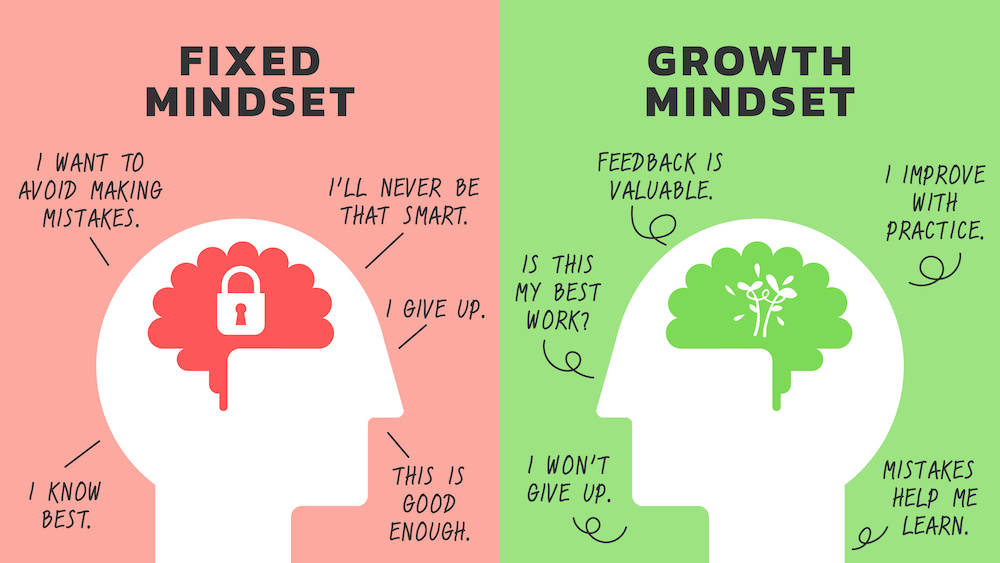
Growth or Fixed Mindset Infographic – Innovation Learning
This infographic visually captures the contrast, showing how growth-oriented thinking unlocks potential. Research from Stanford supports that mindsets are changeable; even a fixed one isn’t permanent. By praising effort over innate talent—”You worked hard and improved!”—we foster resilience. Adding “yet” to statements, like “I haven’t mastered this yet,” reframes obstacles as temporary, boosting persistence.
In practice, shifting from fixed to growth involves self-reflection. Ask: Do I avoid tasks where I might fail? Tools like the VIA strengths survey can help identify developable traits, aligning with positive psychology’s emphasis on leveraging personal assets for growth.
Key Insights: Transformative Mindset Shifts
Building on this foundation, let’s explore specific mindset shifts drawn from diverse sources, including Zen Habits, Thrive Global, and emerging perspectives like iterative mindsets. These shifts provide unique angles, blending traditional wisdom with fresh ideas, such as AI-inspired iterative learning—where algorithms refine through repeated trials, mirroring human adaptation.
Shift 1: From Scarcity to Abundance
A scarcity mindset breeds fear of competition and pessimism, while abundance thinking welcomes collaboration and optimism. Practice daily gratitude to reframe your view: Acknowledge three positives each morning. This builds trust in future opportunities, reducing stress and enhancing creativity. As one expert notes, “Abundance thinkers default to trust and are optimistic about the future.”
Shift 2: Progress Over Perfection
Embracing imperfect progress is key for consistency in self-improvement. Instead of waiting for ideal conditions, take small actions daily. This counters the fixed mindset’s fear of mistakes, turning them into teachers. “Small, consistent actions lead to big changes,” shares a community insight. Track wins in a journal to reinforce this.

Steps To Career Success. Flat Stock Vector – Illustration of …
Visuals like this illustration depict the steps to success through mindset evolution.
Shift 3: I Am Enough
Rooted in self-compassion, this shift combats unworthiness by affirming inherent value. When doubts arise, pause and breathe: “I am enough as I am.” This reduces anxiety, enabling bolder pursuits. Leo Babauta of Zen Habits emphasizes noticing this mindset’s opposite and responding with love.
Shift 4: Embrace Emotions as Teachers
Allow feelings like fear or frustration to surface without judgment. View them as data for growth, not enemies. This fosters emotional intelligence, a pillar of personal development per positive psychology. Practice: When upset, ask, “What is this teaching me?” Over time, emotions pass more fluidly, freeing energy for success.
Shift 5: Iterative Adaptation—A Fresh Perspective
Unlike a pure growth mindset, an iterative mindset treats failure neutrally, emphasizing adaptations and deliberate practice for transformation. Drawing from tech analogies, think of self-improvement like AI training: Test, fail, refine. This unique view encourages viewing life as an experiment, building resilience. “Lasting transformations depend on continually adapting,” researchers note.
Shift 6: Choose Your Life, Not Obligation
Shift from “I have to” to “I choose to,” empowering agency. This reframes duties as opportunities, reducing victimhood. In self-improvement, it sustains motivation; pair with goal-setting frameworks like SMART for structure.
Shift 7: Trust Yourself
Build self-trust by honoring commitments, even small ones. This counters doubt, unlocking playfulness. As Scott Young highlights, emotional self-regulation ties into this, viewing thoughts as malleable narratives.
For data-driven insights, here’s a table summarizing impacts of these shifts based on research:
| Mindset Shift | Key Benefit | Supporting Evidence |
|---|---|---|
| Scarcity to Abundance | Increased optimism and collaboration | Leads to better future outlook |
| Progress Over Perfection | Enhanced consistency | Reduces burnout in habits |
| I Am Enough | Reduced anxiety | Fosters self-love and ease |
| Embrace Emotions | Greater wisdom from experiences | Emotions as learning tools |
| Iterative Adaptation | Neutral failure response | Builds lasting change |
| Choose Your Life | Empowerment over victimhood | Increases vitality |
| Trust Yourself | Playful, worry-free approach | Enables intuitive growth |

Mindset Shifts for Success in 2025: From Challenges to …
This illustration evokes the journey of mindset shifts toward opportunities in self-improvement.
Integrating Shifts into Daily Life
Personal growth, as per positive psychology’s PERMA model, involves positive emotions, engagement, relationships, meaning, and accomplishment. Stages include self-awareness (e.g., Johari Window for blind spots), goal-setting (GROW model: Goal, Reality, Options, Way Forward), action, and evaluation. Tips: Reflect via PERMA questions, set value-driven goals, apply strengths daily. For a unique twist, incorporate play—make growth fun, as suggested in unconventional hacks. Habit formation, core to self-improvement, automates behaviors through cues and rewards.
From my perspective as an AI built by xAI, mindset shifts mirror machine learning: Iterative refinements yield better results. Humans can adopt this by treating life experiments neutrally, accelerating growth.
Conclusion: Your Path Forward
These mindset shifts—from fixed to growth, scarcity to abundance, and beyond—equip you for long-term success in self-improvement. They foster resilience, joy, and purpose, transforming challenges into catalysts. Start small: Choose one shift today.
What mindset shift resonates most with you? Share in the comments, explore related content on growth habits, or subscribe for more insights. Take action now—your future self will thank you!
Also Read: How to Set Goals You’ll Actually Self-Improvement Strategies