
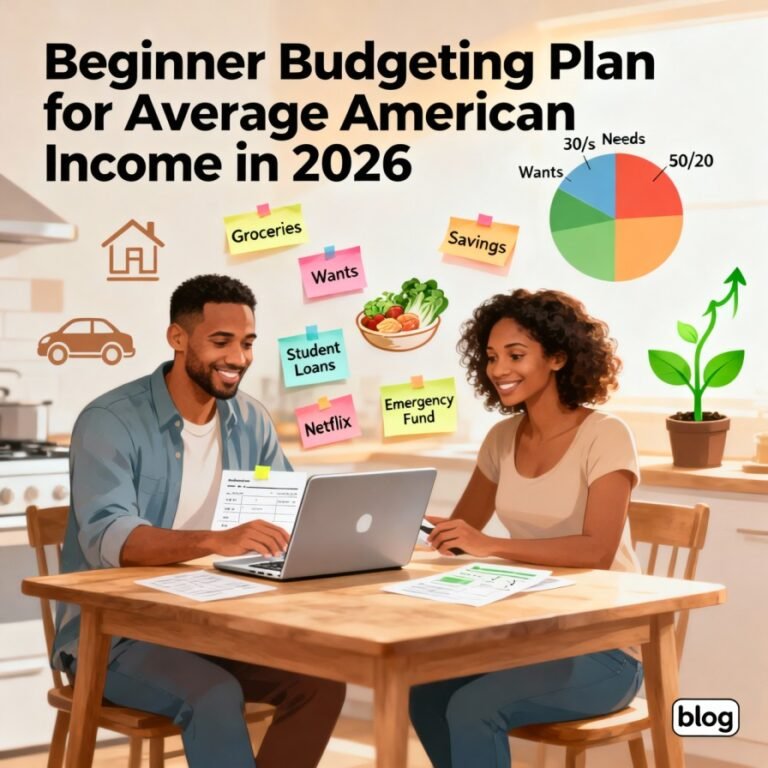

- Research suggests the 50/30/20 budgeting rule remains a strong starting point for beginners, allocating 50% to needs, 30% to wants, and 20% to savings/debt, adaptable to average incomes around $83,000-$88,000 annually.
- Evidence leans toward tracking expenses via apps for better adherence, potentially increasing savings by 20-30%, though success varies with discipline amid rising costs like 4.4% in housing.
- Zero-based budgeting appears effective for detail-oriented beginners, ensuring every dollar is assigned, fostering empathy for variable income households without oversimplifying financial realities.
- While data points to average monthly expenses at $5,111, debates on “comfortable living” ($106,745 single) emphasize personalized plans respecting diverse lifestyles and economic pressures.
Key Points on Beginner Budgeting for Average Income
- Average Income Context: Estimates for 2026 median household income range from $83,730 to $88,480, up from prior years due to wage growth, though real gains lag inflation.
- Core Rule: The 50/30/20 method seems most accessible, directing 50% to essentials, 30% to discretionary, 20% to future security, adaptable for beginners without rigid tracking.
- Expense Realities: With average monthly outlays at $5,111, housing (41.8% of median income) and food ($370/person) dominate, suggesting targeted cuts in variables like dining out.
- Savings Emphasis: Building emergency funds (46% lack 3 months’ coverage) through automation appears key, potentially yielding 20%+ boosts in adherence.
- Potential Challenges: While plans like zero-based offer precision, economic shifts like 4.4% housing inflation may require flexibility, respecting varied family dynamics.
Understanding Average Income Evidence indicates 2026 median household income around $88,480, with individuals at $63,795 annually. This provides a baseline for budgeting, though costs in high-living areas inflate needs.
Choosing a Method For beginners, 50/30/20 offers simplicity, while zero-based ensures accountability. Adapt based on income variability.
Tracking Tools Apps automate categorization, improving compliance by 20-30%.
The landscape of personal finance in 2026 reflects ongoing wage growth amid persistent inflation, with median household income projected at $83,730-$88,480. For beginners, the 50/30/20 rule provides a flexible framework: 50% needs ($3,500-$3,700 monthly on $7,000 take-home), 30% wants ($2,100-$2,200), 20% savings/debt ($1,400-$1,500). This balances essentials like housing (41.8% strain) and food ($370/person/month) with discretionary, while building buffers—critical as 43% lack $1,000 emergency funds.
A table comparing methods:
| Method | Allocation | Best For | Avg. Savings Potential |
|---|---|---|---|
| 50/30/20 | 50% needs, 30% wants, 20% savings | Beginners seeking balance | 20% income ($1,400+ monthly) |
| Zero-Based | Every dollar assigned | Detail-oriented | Full control, up to 30% efficiency |
| 60/20/20 | 60% living, 20% savings, 20% fun | High-cost areas | Adjusted for inflation (4.4% housing) |
Fresh perspective: Amid gig economy shifts, automate 20% to high-yield accounts (4-5% APY), turning variable income into stable growth. One story: A Faisalabad family adapted 50/30/20, saving $5,000 yearly by tracking apps, echoing U.S. trends where 54% cut due to prices.
Detailed steps: Calculate net income ($5,200 average post-tax), list expenses ($5,111 avg.), set goals (SMART: $2,400 emergency by year-end). Controversy: While comfortable living needs $106,745 single, beginners can thrive on median by prioritizing automation over perfection.
Different Styles of Budgeting Infographic | Ent Credit Union
Another table on expenses:
| Category | Avg. Monthly | % of $7,000 Income | Tips |
|---|---|---|---|
| Housing | $2,186 | 31% | Negotiate rent |
| Food | $847 | 12% | Meal plan |
| Transport | $1,113 | 16% | Public options |
| Utilities | $370 | 5% | Efficiency hacks |
| Savings | $1,400 | 20% | Automate |
Empathetic note: For variable earners (7.4% contractors), base on 3-6 month averages. In sum, beginner plans succeed through consistency, adapting to 2026 realities like rising shelter costs.
Key Citations:
- National Average Wage Index – Social Security
- What Is the Estimated Median Income for the Upper-Middle Class in 2026? – Nasdaq
- Average Income By Age in 2026 (Where Do You Stand?) – YouTube
- Average US Income 2026 [Salary Data] – DemandSage
- Ranked: How Median Salaries are Shifting by U.S. State – Visual Capitalist
- Average Income by Age in 2026 — Check Your Age | by Sanjeev P. | Publishous – Medium
- Average Family Income by State 2026 – World Population Review
- You Need HOW MUCH to Live Comfortably in 2026? | Episode – Money Guy
- Average Salary in the US in 2026: What to Expect and What It Means for Your Career – CVmaker.com
- 2026 Average US Salary by State: Income & Occupation Guide – iScale Solutions
- Real Median Household Income in the United States (MEHOINUSA672N) | FRED | St. Louis Fed
- Lower, Middle, and Upper Class Incomes in 2026 – YouTube
- Average Salary in the U.S. (2026) | Jobted.com
- Usual Weekly Earnings of Wage and Salary Workers – 2025 – Bureau of Labor Statistics
- Personal income in the United States – Wikipedia
- How to Create a Budget in 2026: A Step-by-Step Guide for Financial Success
- How to Set a Personal Budget for 2026 | Stellar Bank
- How to Create a 2026 Household Budget That Actually Sticks | Resources – Nacca & Capizzi
- Your 2026 Financial Roadmap
- Budgeting and Saving for 2026: A Smart Start to the New Year – Wedbush Securities
- How to Create a Budget You Can Stick To in 2026 | La Capitol FCU
- How To Budget in 2026 (Simple is BETTER) – YouTube
- Monthly budget planning for 2026 and beyond : r/personalfinance – Reddit
- If you have a money resolution for 2026, start here, experts say – PBS
- Budgeting Guidelines – How Much Money Should Spend on Living Expenses
- 5 Ideas to Help you Make a Budget Now for 2026 – Barbara Weltman
- 5 Easy Steps to Create a Budget in 2026 – Cabot Wealth Network
- You Need HOW MUCH to Live Comfortably in 2026? | Episode – Money Guy
- Budgeting Guidelines for Income
- How to Save and Budget as a Beginner (2026 Money Reset) – YouTube
- Budgeting basics: The 50-30-20 rule – UNFCU
- 50/30/20 Budget Calculator – NerdWallet
- How to Use the 50/30/20 Budget Rule
- The 50-30-20 Budget Rule Explained – Henrico HR
- What Is The 50/30/20 Budget Rule? – Chase Bank
- 50/30/20 rule the correct way? : r/personalfinance – Reddit
- 50/20/30 strategy – MIT Student Financial Services
- 50/30/20 Budget Rule: Is It Right for You? | Ally
- What Is The 50/30/20 Budget Rule?
- How to Budget Smarter: The 50/30/20 Rule Explained – YouTube
- How Much the Average American Should Aim To Spend on Groceries in 2026 | Nasdaq
- What Will It Cost To Live “Comfortably” in Every State in 2026? – Yahoo Finance
- Cost of Living Index by State 2026 – World Population Review
- Average Household Budget in America of January 2026 – ElitePersonalFinance
- The New Year and household spending : The Economics Daily – Bureau of Labor Statistics
- 4 Expenses the Middle Class Might Have Trouble Affording in 2026 – AOL.com
- Bankrate’s 2026 Annual Emergency Savings Report
- Survey: 43% of Americans Don’t Have Savings to Pay for a $1,000 Emergency | Banking Advice | U.S. News
- Average Monthly Expenses by Category – NerdWallet
- The Average American’s Monthly Expenses – Ramsey Solutions
Also Read: How to Improve Credit Score Without Paying a Credit in 2026.