
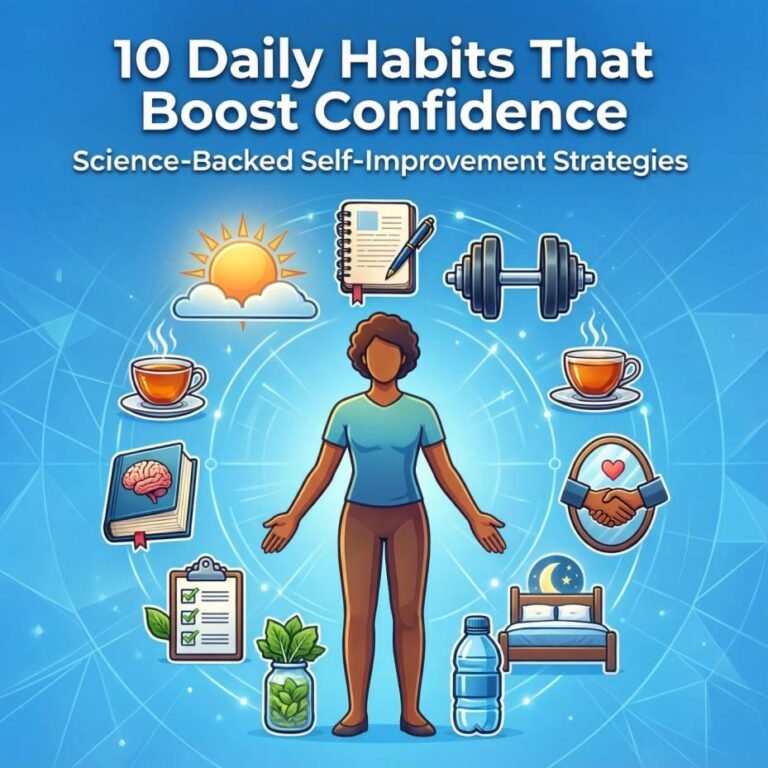

Confidence isn’t a lucky trait some people are born with — it’s a collection of small choices you repeat. In this post you’ll find ten research-backed, actionable daily habits you can start today. These are grounded in science, shaped for real life, and written so you can pick one or two and watch your self-belief grow.
Quick comparison: short wins vs long-game habits
Short wins (5–20 minutes) give immediate mood boosts and quick momentum. Long-game habits (sleep, skill practice, relationships) compound over weeks and months to create durable self-trust.
| Habit type | Typical time | Immediate effect | Long-term payoff |
|---|---|---|---|
| Micro-wins (e.g., tidy desk) | 5–15 min | Boosts pride, reduces overwhelm | Builds momentum habit loop |
| Rituals (journaling, gratitude) | 5–20 min | Better mood, clarity | Rewires focus toward positives |
| Physical habits (exercise, sleep) | 30+ min / nightly | Mood lift, alertness | Stable self-esteem, resilience |
| Skill practice (learning) | 20–60 min | Sense of progress | Competence → sustainable confidence |
Science-backed sources
(If you want to dig deeper: I relied on major reviews and empirical studies from trusted outlets and journals.)
Mayo Clinic — exercise & mood.
PubMed — sleep & self-esteem literature.
James Pennebaker — journaling/expressive writing.
Emmons & McCullough — gratitude intervention studies.
Harvard Business Review — small wins / progress principle.
The 10 habits (practical, evidence-informed, and easy to start)
1. Move your body (even 20 minutes)
Daily movement — a brisk walk, a short workout, yoga — reliably improves mood, lowers anxiety, and raises self-perception of capability. Start with a 20-minute habit after breakfast: it sparks energy and creates a “I did it” feeling that builds confidence over time.
Try: A 20-minute walk + 5 minutes of conscious breathing. Track days you move on your phone calendar.
2. Own your mornings with a micro-ritual
A tiny morning ritual (make your bed, hydrate, 2 minutes of posture check) creates predictability and reduces decision fatigue. Repeating one small action every morning signals you can follow through — the foundation of self-trust.
Try: Make the bed, drink a glass of water, and write one daily intention (one sentence).
3. Capture small wins — log progress daily
Noticing micro-progress (chapter read, email sent) prevents the “nothing’s happening” trap. Research on the “progress principle” shows that perceiving small forward motion is one of the strongest motivators for engagement and confidence.
Try: Keep a visible sticky note with today’s 3 tiny wins. Celebrate them.
4. Write for clarity: 10 minutes of expressive journaling
Putting thoughts into words — especially about challenges and lessons — helps you process emotions, lowers rumination, and strengthens mental clarity. Decades of research on expressive writing show measurable benefits for psychological well-being.
Try: 10 minutes nightly: free-write about one thing that mattered today and one lesson learned.
5. Practice gratitude (but keep it simple)
A short gratitude habit—three things you noticed today—shifts attention toward resources and away from scarcity thinking. Experimental studies of gratitude journaling report increases in positive affect and resilience.
Try: Each evening, write 3 small things you were grateful for (it can be tiny—coffee steam, a helpful text).
6. Prioritize sleep — real confidence begins with rest
Poor sleep is linked to lower optimism and self-esteem; consistent, quality sleep supports emotion regulation and clear thinking. Treat sleep like a non-negotiable: it’s the foundation that enables all other habits.
Try: Set a wind-down routine (screens off 60 minutes before bed, dim lights, 7–8 hours target).
7. Learn one small skill (compound competence)
Confidence feeds on competence. Spend 20–40 minutes a day learning a skill that matters to you — public speaking, coding, a craft. Over weeks, small practice sessions add up into real expertise, and expertise produces authentic confidence.
Try: Follow a weekly micro-course: 3 short lessons a week + one 20-minute practice block daily.
8. Sharpen body language with intent (not myths)
While the idea of a quick “power pose” as a magic bullet is misleading, using open, engaged body language during interactions helps you appear and feel more confident. Focus on eye contact, a calm voice, and measured movements rather than trying to fake a posture miracle. (Researchers recommend real skill/experience over quick tricks.)
Try: Before conversations, take 30 seconds to breathe, square your shoulders, and plan one clear sentence you’ll say.
9. Connect for feedback and reality checks
Confident people don’t isolate — they seek honest feedback and calibrate their self-view. A trusted friend or mentor helps you separate constructive critique from self-doubt and spot progress you might miss.
Try: Weekly 15-minute check-ins with a friend or mentor: one win, one hurdle, one request for feedback.
10. Practice self-compassion and realistic self-talk
Confidence is not absence of fear — it’s a compassionate partner for fear. Replace harsh “I failed” monologues with neutral, curious language (“That didn’t go how I hoped; what can I try next?”). Cognitive reframing and self-compassion lower the emotional intensity of setbacks and keep you moving.
Try: When a mistake happens, pause and name the emotion for 10 seconds, then write one concrete action to try next time.
Quick habits checklist (printable)
- Move 20 min (walk/workout) ✔
- Drink water + one morning intention ✔
- List 3 wins each day ✔
- Journal 10 min (lesson learned) ✔
- Write 3 gratitudes nightly ✔
- Bedtime routine for 7–8 hours ✔
- 20–40 min skill practice ✔
- 30 sec breathing before conversations ✔
- Weekly feedback check-in ✔
- Use self-compassion statements ✔
Visuals & internal linking ideas
- Image ideas: a clean, sunny morning desk, a small wins sticky note, before/after bed routine infographic.
- Infographic suggestion: “The Confidence Stack” — layered visuals showing Sleep → Movement → Micro-wins → Skill Practice.
- Internal links: link to posts like “Morning Routines,” “How to Start Journaling,” or “Beginner Fitness at Home” to keep readers on your site and reduce bounce rate.
Final thoughts
Confidence is less a trait and more a byproduct of tiny, repeated choices. Pick 2 habits from this list, commit for 21 days, and let the ripple effects begin. Want a ready-made 21-day plan using these habits I just outlined (with daily prompts and a printable checklist)? Reply “21-day plan” and I’ll draft one you can post or email to subscribers.
If you found this useful, share it, save the printable checklist, and tell me in the comments: which habit will you start tomorrow?
Also Read: Personal Finance Tips Every American Knows for a Secure Future