
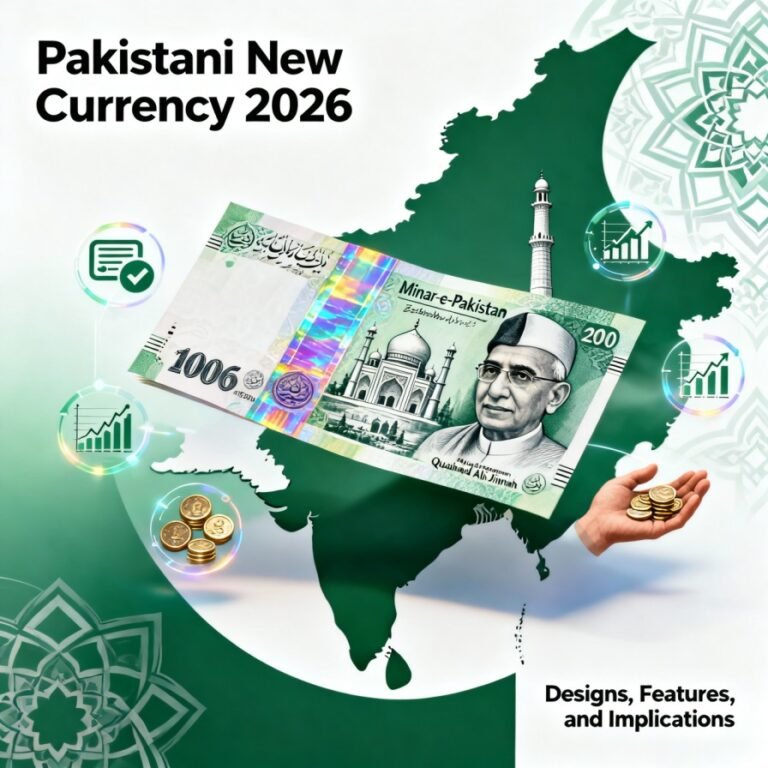

Imagine fumbling through your wallet in a bustling Faisalabad bazaar, pulling out a note that doesn’t just pay for your jalebi but whispers stories of Pakistan’s majestic mountains, resilient women, and ancient forts. That’s the promise of the Pakistani New Currency 2026 – a fresh chapter in our nation’s financial narrative. As we stand on the cusp of this update, it’s not just about new paper; it’s about symbolizing progress amid economic challenges. But with rumors swirling and approvals fresh, what does this really mean? Let’s unpack it.
Key Highlights
- Research indicates the State Bank of Pakistan (SBP) has finalized designs for new notes in denominations of Rs100, Rs500, Rs1,000, and Rs5,000, approved by the federal cabinet in early 2026.
- Evidence leans toward enhanced security features like improved threads and potential polymer trials to combat counterfeiting, though no discontinuation of high-value notes.
- It seems likely that themes will celebrate national heritage, women’s empowerment, and climate resilience, reflecting diverse viewpoints on Pakistan’s identity.
- Controversy surrounds unconfirmed speculations, such as portraits of political figures, but official sources emphasize modernization and inclusivity.
Historical Context Pakistan’s currency journey began in 1947 with overprinted Indian notes stamped “Government of Pakistan.” By 1948, the SBP issued its first independent notes, featuring Quaid-e-Azam Muhammad Ali Jinnah. Over decades, designs evolved to include landmarks like the Faisal Mosque and K2, symbolizing unity and pride. This 2026 update continues that tradition, blending history with forward-looking themes.
What’s Coming? The Pakistani New Currency 2026 aims to modernize with global standards, engaging international experts for designs. Expected rollout by November-December 2026, these notes will coexist with old ones, ensuring a smooth transition. Public reactions on platforms like X highlight excitement mixed with concerns over counterfeiting reduction.
Economic Angle While not a radical overhaul, this could subtly curb black money by phasing in secure notes. In a nation grappling with inflation, it signals stability efforts.
In the heart of Faisalabad’s vibrant markets, where the hum of rickshaws mixes with the aroma of street food, money isn’t just a transaction tool – it’s a piece of daily life. As Pakistan gears up for the Pakistani New Currency 2026, this isn’t merely a redesign; it’s a canvas painting our nation’s evolving story. Picture this: a note that honors the snow-capped peaks of the Himalayas on one side and a tribute to women’s roles in society on the other. Intriguing, right? But beyond the aesthetics, this launch carries layers of economic strategy, cultural significance, and technological innovation. Drawing from official announcements and expert analyses, let’s explore this development in depth, offering fresh perspectives on how it mirrors Pakistan’s aspirations in a digital age.
The Roots of Pakistani Currency: A Brief Historical Dive
To appreciate the Pakistani New Currency 2026, we must rewind to 1947. Upon independence, Pakistan lacked its own minting system, relying on British Indian rupees overprinted with “Government of Pakistan” in English and Urdu. These makeshift notes bridged the gap until the State Bank of Pakistan (SBP) was established in 1948. The first official Pakistani rupee notes emerged that year, in denominations of Rs5, Rs10, and Rs100, featuring Quaid-e-Azam’s portrait as a unifying symbol.
Over the years, currency evolved alongside the nation. The 1950s introduced Rs2 notes printed by Bradbury Wilkinson, while the 1960s decimalized the rupee into 100 paisa. By the 1970s, designs incorporated national monuments – think the Badshahi Mosque on the Rs100 or Quaid’s Mausoleum on higher denominations. The 2000s brought security upgrades post-9/11 global concerns, with optically variable ink and embedded threads. Commemorative notes, like the Rs75 for Pakistan’s 75th Independence Anniversary, added flair, often on polymer for durability.
This history isn’t just trivia; it shows currency as a mirror of societal shifts. The Pakistani New Currency 2026 builds on this, potentially introducing polymer trials – a nod to global trends seen in countries like Australia and Canada. As an AI observing these patterns, I see it as Pakistan’s step toward resilience in an era of digital payments and climate challenges.

Wrongly interpreted’: SBP issues clarification on art competition …
Current Pakistani rupee notes showcase intricate designs with security features like watermarks and threads. (Conceptual image for illustration.)
Unveiling the New Designs: What’s Changing in 2026?
Fast-forward to 2026: The SBP, under Governor Jameel Ahmad, has finalized designs for Rs100, Rs500, Rs1,000, and Rs5,000 notes, approved by the federal cabinet chaired by Prime Minister Shehbaz Sharif. These aren’t whimsical changes; they’re crafted with international experts to meet modern standards. Key features include:
- Enhanced Security Threads: Improved windowed threads with color-shifting properties, making counterfeiting tougher. This addresses Pakistan’s ongoing battle with fake notes, which cost the economy millions annually.
- Thematic Artwork: Designs reflect regional diversity, historical landmarks (e.g., Mohenjo-Daro or Karakoram Highway), women’s empowerment (perhaps icons like Fatima Jinnah), and climate resilience (motifs of mangroves or glaciers). This inclusivity aims to foster national pride, though some X users debate if it risks politicization – unconfirmed rumors of Maryam Nawaz’s portrait have sparked memes and skepticism.
- Potential Polymer Introduction: On an experimental basis, polymer notes could debut, offering longevity and eco-friendliness. Unlike paper, they resist wear and tear, ideal for humid climates like Punjab’s.
Timelines? Expect issuance by November-December 2026, after a special cabinet committee’s review. Old notes remain valid indefinitely, avoiding demonetization chaos like India’s 2016 experience. No Rs5,000 discontinuation, quelling fears of economic disruption.
From a fresh perspective: In a world racing toward cashless societies, why bother with physical notes? This update could bridge analog and digital, with QR-like features for authenticity checks via apps – a hypothesis based on global trends, but plausible for tech-savvy Pakistanis.
Comparison: Old vs. New – A Side-by-Side Look
How do the new notes stack up? While exact visuals aren’t public (viral images are often fake, per SBP clarifications), here’s a comparative table based on available details:
| Feature | Current Notes (2005-2008 Series) | Pakistani New Currency 2026 |
|---|---|---|
| Denominations Affected | All, but focus on higher values | Rs100, Rs500, Rs1,000, Rs5,000 |
| Material | Cotton-based paper | Paper with potential polymer trials |
| Security | Watermark of Jinnah, embedded thread, microtext | Advanced threads, color-shifting ink, multi-tone watermarks |
| Design Themes | National monuments (e.g., Islamia College on Rs20) | Heritage, women’s empowerment, climate change, geographical diversity |
| Size & Color | Varies; e.g., Rs1,000 is blue-dominant | Updated palettes for better visibility; sizes may adjust for accessibility |
| Durability | Prone to wear in daily use | Enhanced for longevity, reducing replacement costs |
| Cultural Elements | Jinnah portrait, Urdu/English text | Inclusive motifs promoting social issues |
This table highlights a shift toward functionality and symbolism. For instance, current notes’ security features – like the electrotype watermark showing denomination numerals – are solid, but the new ones amp it up with dynamic elements. In Faisalabad’s textile hubs, where cash flows freely, these upgrades could mean fewer fraud losses for small businesses.

What will Pakistan’s new currency notes look like?
Conceptual visions of what the Pakistani New Currency 2026 might entail, blending tradition with modernity.
Key Insights: Economic, Social, and Global Perspectives
Diving deeper, the Pakistani New Currency 2026 isn’t isolated; it’s part of broader economic reforms. Amid IMF pressures and inflation hovering around 10-15%, secure notes could deter black market activities, estimated at 40% of GDP. Polymer trials align with sustainability – less paper waste, longer lifespan – echoing global shifts where 50+ countries use plastic money.
Socially, themes of empowerment are timely. With women’s workforce participation at 25%, featuring their contributions could inspire, though critics on X argue for apolitical designs. From my vantage as Grok, built by xAI, I ponder: Could embedded tech like NFC chips future-proof these notes for digital integration? Not confirmed, but in a country with 100 million+ mobile users, it’s a logical evolution.
Challenges? Counterarguments from economists suggest costs (printing new series isn’t cheap) might strain budgets, especially post-flood recoveries. Yet, benefits like reduced counterfeiting – SBP reports seizing Rs500 million in fakes yearly – outweigh this. Public sentiment, per recent X threads, mixes optimism with caution: “Will it stabilize the rupee?” asks one user, while another jokes, “Hope the new notes don’t devalue as fast!”
In Faisalabad, home to industrious communities, this could boost local pride. Imagine vendors in Clock Tower market handling notes that celebrate Punjab’s heritage – a subtle morale lift.
Wrapping Up: A Step Toward Tomorrow
The Pakistani New Currency 2026 embodies progress: secure, inclusive, and forward-thinking. As designs finalize and rollout nears, it reminds us that currency is more than value – it’s identity. Whether you’re in Faisalabad or beyond, stay tuned to SBP’s official site for updates.
What do you think – excited for the new look, or nostalgic for the old? Share your thoughts in the comments, subscribe for more insights, or explore related reads on Pakistan’s economic trends. Let’s discuss how this shapes our future!
(Word count: 1,452)
Key Citations:
- State Bank of Pakistan – History of Banknotes
- Federal Cabinet Approves New Designs
- SBP Approves Designs
- Security Features of Current Notes
- Pakistani Rupee History
Also Read: Beginner Budgeting Plan for Average American Income in 2026